27/03/2016
New Posts for walking on La Palma have a change of address
Hello there and we hope you enjoy our blog all about walking on La Palma. For new blog posts of all subjects, please go to the main Holiday la Palma Blogspot. Hope to see you there!


03/08/2015
Walking the Cuba de la Galga, Puntallana, La Palma
With so many walking routes on La Palma - over 1,000km of marked trails by the way - I guess we're always going to be spoiled for choice. So why choose a walk that we have already done twice before? The answer is simple : with the use of Endomono, we were after some facts and figures for our new La Palma Highlights Tour. Oh and yes, to break free!!!
So, mission Cubo de la Galga ...


Along the way there is a magnificent 25m high mahogany tree. I think most of us have only heard of mahogany in the context of furniture, a very valuable, rich-red wood. This used to be called the Canary Islands Ebony.


So now we've arrived at La Fajana. You might notice on your travels around La Palma that there are quite a few places called La Fajana which is because it's a descriptive name, meaning 'flat place.' A flat place on La Palma, the most mountainous island in the world for its size, it particularly noteworthy!
 And here's the point on the walk where you will have to make a decision - to go left or right.

 We headed on up to the Somada Alta for old times sake, stopped for our lunch and to take some photos of course.
So, mission Cubo de la Galga ...

Over the years, the Cuba de la Galga walk has become increasingly popular. With an information hut and large car park at the start of the walk, it's easy to judge its popularity just by the number of cars! But happily it's one of those walks that's never crowded or gives you sense of being part of a walking tour with a whole load of other people.

And the nice thing is that it can be tackled in a variety of ways, either as a circular, partly circular or linear walk. The last time we walked it, we chose the partly circular option and with the use of a car for the first kilometre but this time we were more interested in walking a completely circular route right from the start.
The photo above shows how lovely it is and with the information sheet with numbered points of interest which is obtainable from the warden, (weekdays only up until 14.00hrs, linear route only) it was nice to take our time, take photos and just enjoy it!
 |
| The height of the flora covered ravine walls are impressive - you can just see David stood bottom left of photo |
At beginning of the walk, you soon get the sense of being in some sort of pre-historic forest. Located in the high-sided ravine of La Galga, this is apparently one of the best examples of laurels in the whole of the Canaries. With huge ferns and the ancient laurisilva, it's also home to many birds in particular the wood pigeon which you can hear calling softly in the background.
 |
| Mahogany tree |

One of my favourite parts is quite near the start where you walk under the aqueduct. Yes, this is really where water was chaneled across, going from one side of the barranco (ravine) to the other.

In fact, if you clamber up this little slope, you will actually be able to see the channel, although it is not in current use so doesn't have water flowing through it.

As the gorge has been channeled out by water and natural erosion over time, it is still very much in the making. For example, this huge stone will surely fall one day although it looks pretty well wedged in for the moment. (I'm sure I'm not the only one who thinks it's a great idea to stand underneath it and get a photo taken).
Later on the walk, you get to go through this archway (small aqueuct) and into the magic garden of La Galga.


So now we've arrived at La Fajana. You might notice on your travels around La Palma that there are quite a few places called La Fajana which is because it's a descriptive name, meaning 'flat place.' A flat place on La Palma, the most mountainous island in the world for its size, it particularly noteworthy!
 And here's the point on the walk where you will have to make a decision - to go left or right.
Both ways will eventually take you up to the Somada Alta with its fantastic view of Los Sauces and Puntallana, but the routes are quite different.

From this very pleasant walk uphill through the forest, the road is reached and, if you wish, the Somada Alta via a steepish climb upwards through the forest.
 We headed on up to the Somada Alta for old times sake, stopped for our lunch and to take some photos of course.
Returning to the car was via a shorter route and certainly different as it gave us a chance to look at some of the rural houses, las casas rurales, of La Palma. And a great sea view along the way!
Would we walk it again? Certainly would. And more than that, it has gained a place in a La Palma Highlights Walking Tour.
05/04/2015
Treking on the GR131 El Baston - final section!
 |
| Roque de Muchachos at 2426m asl on a non-walking day! |
 |
| The GR131 is the red line going up the middle and hooks round to the mid-west. |
So here's a summary of the long distance trekking route, GR131 El Baston.
The route can be walked in either direction by starting at the extreme south below Los Canarios or at the Puerto de Tazacorte in the west. But whichever way you look at it, the sections tend to be divided:1. El Faro (lighthouse) of Los Canarios/Fuencaliente to the Zona Recreativa de El Pilar
2. El Pilar to Roque de Muchachos
3. Roque de Muchachos to Puerto de Tazacorte
 |
| The Volcano Route |
The logistics are not completely easy as along the whole route, there is nowhere to buy food or drink and no accommodation apart from the un-manned Refugio de Los Roques (which is between El Pilar and Roque de Muchachos). However, there is drinking water at El Pilar campsite along with toilets and showers, plus BBQ facilities. There is rain water at Refugio de los Roques (but you must use sterilizing tables). Normally there is water at the Roque de Muchachos but the tap can be frozen in winter.
 |
| El Pilar - ready for any weather and an overnight stop at the Refugio Los Roques |
23.63km - Los Canarios to Refugio El Pilar (the Volcano Route)
28.1km - Refugio El Pilar to Roque de Muchachos
17.9km - Roque de Muchachos to Puerto de Tazacorte
 |
| Reventon Pass - this is your get-out clause down to either el Paso or Santa Cruz |
7.2km - Faro de Fuencaliente to Los Canarios
18.4km - Refugio El Pilar to Pico de la Nieve
7 km - Refugio El Pilar to Reventon Pass
9.7km - Pico de la Nieve to Roque de Muchachos
4.9km - Pico de la Cruz to Roque de Muchachos
10.7km - Roque de Muchachos to Torre del Time
3.5 km - Mirador el Time to Puerto de Tazacorte
(I can't claim that the distances are 100% accurate as the data is taken from the walking signs)
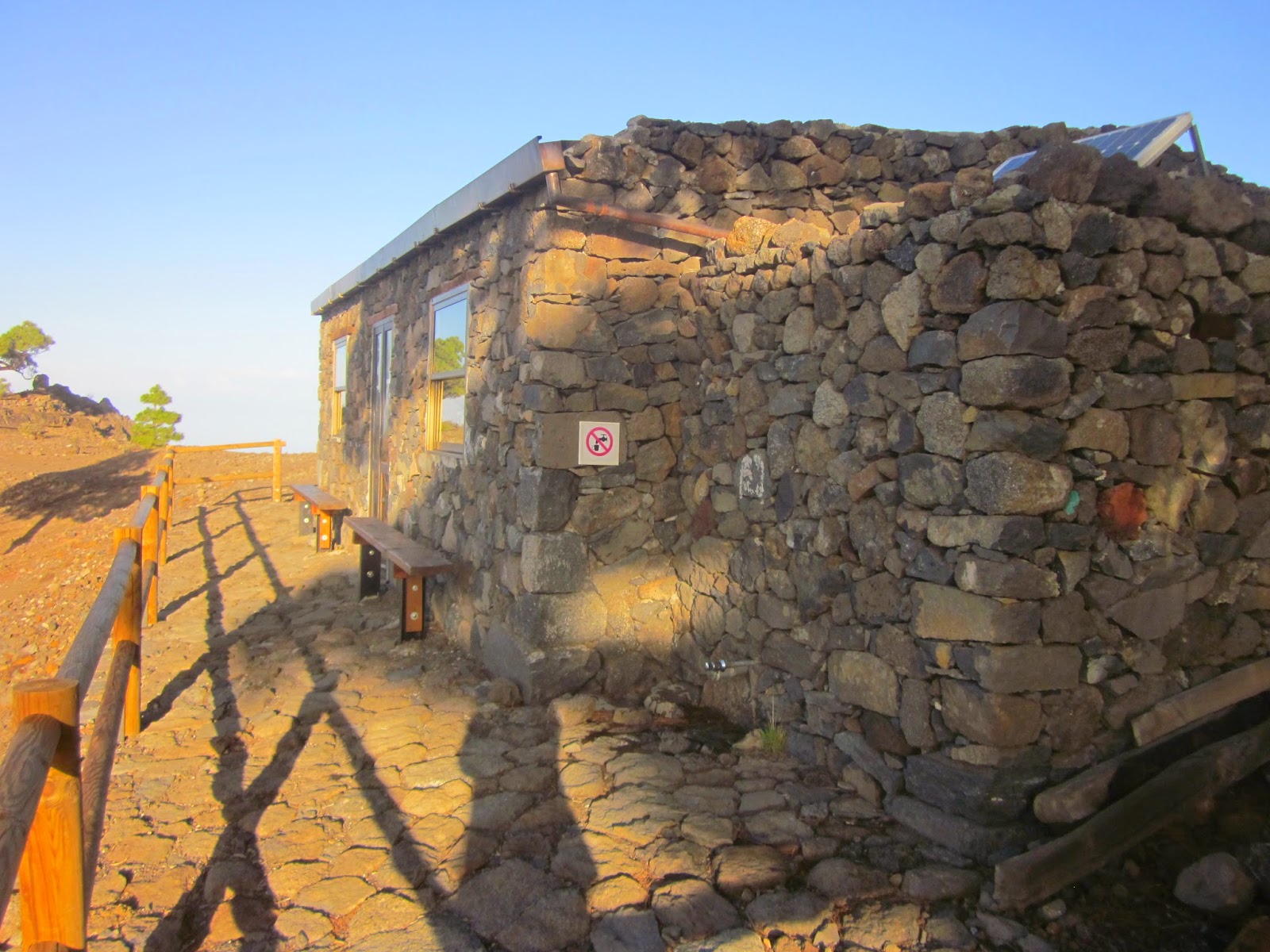 |
| Dawn at Refugio Punta de los Roques (I've just got to go back there!) |
You don't need a permit for the Refugio de los Roques and it is never locked. It has a great system of entry with an inner and outer heavy metal door. This means that the wind can't blow the door open so it is not full of leaves and dust and forest animals can't enter either. But you will need a sleeping bag and preferably a ground pad/yoga mat. See our previous post.
 |
| January 2015 near Pico de la Cruz - it can be cold even when sunny! |
 |
| Pico de la Cruz (not the most beautiful landmark ...) |
http://www.senderosdelapalma.com/es/senderos/senderos_por_isla.php
Which section has been my favourite I hear you ask. Without having to think about that hardly at all, I would say from the Reventon Pass to Pico de la Cruz, the reason being is that it is the most inaccessible and least walked. It gives the sensation that you are walking in some place far, far away from civilization, somewhere really special. Well, you are.
 |
| Information board at Mirador Los Andenes |
The highlight, or one of them at least, is reaching the Refugio de los Roques. I might be over-exaggerating but it's the Trip Advisor camping equivalent of a Parador (elite Spanish accommodation) in that you can only get there if you've walked the walk. And we did.
For accommodation at the Puerto de Tazacorte where the GR131 begins/ends, take a look at our main website, Holiday La Palma.
 |
| Sleeping platforms at Refugio de los Roques It's been a hard day's night |
30/10/2014
Walking the GR131 El Baston from El Pilar to Pico de la Nieve (and beyond)
It seems ridiculous to say that I've wanted to do a particular walk on La Palma for years, yes literally years, and still not done it. I mean, why wouldn't you just go and do a walk if you want to do it, especially when we live just a 50 minute drive away from one end of it. But the fact is that this isn't an ordinary walk - no, we're talking logistics here. And an overnight stay in a refuge hut.
 So finally having given up on waiting for the 'right time' to walk it, when it's not too hot, not too cold and we're not too busy or too unfit, it was a case of just doing it. I have to say that it was probably not the most perfect time, especially as we couldn't start the walk until late-afternoon but sometimes walkers can't be choosers. And so off we set with the small matter of 28km of fairly continuous ascents and descents most of which is at altitude, bed rolls and sleeping bags. Glee :) I love an adventure...
So finally having given up on waiting for the 'right time' to walk it, when it's not too hot, not too cold and we're not too busy or too unfit, it was a case of just doing it. I have to say that it was probably not the most perfect time, especially as we couldn't start the walk until late-afternoon but sometimes walkers can't be choosers. And so off we set with the small matter of 28km of fairly continuous ascents and descents most of which is at altitude, bed rolls and sleeping bags. Glee :) I love an adventure...
The start of the walk was crazy-easy with the walking path crisscrossing over a forestry track. But nice to be able to walk over the pine needles on the ground with the tree heather lining the path. And within an hour, we are starting to get some tantalizing views. I don't know if it's what I had expected, we're used to outstanding views, but I hadn't seen this one.


And not too much further along the route, we came to the aerials we had seen not so long ago in the distance. This was something of a way-point and we were making pleasing headway. Plus some even better views over to the east as picked we out Los Cancajos and the airport in the distance.


Perhaps a more significant waypoint was reaching the Reventon Pass, the intersection of the GR131 and LP1 walking route which crosses the centre of the island from Santa Cruz in the east, up and over to the Virgen del Pino at El Paso and eventually to Tazacorte in the west. It's 7km from El Pilar and another 7km to the Refuge hut - it's a good place to pause a while, top up with drinking water from the fountain and enjoy the view of both the east and the west.

By the way, the red line on the map above shows the whole route of the GR131 - this is the one that the Transvulcania athletes run in day. I kid you not.
I think it was after this point that the route started to get a bit more serious with an amazing number of ascents and descents kicking in, especially considering that overall we were not gaining a huge amount of altitude. Oh well, así es la vida, full of ups and downs.

With fabulous views continuing we didn't hang around long to take photos but it was more a case of taking in the view while still walking. After all, darkness falls quickly and we still had a long way to go. So speeding up as much as possible, we walked the last part in increasing gloom and when we finally reached the refugio, it was all but dark. Happily (if that's the word) we had armed ourselves with torches.
By the way, the red line on the map above shows the whole route of the GR131 - this is the one that the Transvulcania athletes run in day. I kid you not.
I think it was after this point that the route started to get a bit more serious with an amazing number of ascents and descents kicking in, especially considering that overall we were not gaining a huge amount of altitude. Oh well, así es la vida, full of ups and downs.
With fabulous views continuing we didn't hang around long to take photos but it was more a case of taking in the view while still walking. After all, darkness falls quickly and we still had a long way to go. So speeding up as much as possible, we walked the last part in increasing gloom and when we finally reached the refugio, it was all but dark. Happily (if that's the word) we had armed ourselves with torches.
 Now, I've never been to the Refugio before although I've seen photos and heard reports about it, but I must say I was very pleasantly surprised. I had somehow imagined bare bunk beds with broken lats, a creaky door hanging off its hinges and a dusty soil floor. But in fact it's an absolutely brilliant little building with quite two quite big rooms, one with good, strong, clean sleeping platforms and the other with two large tables and benches. Oh and a heavy, self-closing front door immediately followed by a heavy self-closing interior door with zero change of blowing open in the night. There are a few basics to help walkers too - an excellent first aid kit and some sweeping brushes to keep the place clean and free of tasty morsels dropped on the floor. Outside there is a water tap, although water purifiers are recommended. The Refugio is completely free of charge, does not need a permit and is never locked.
 I can't say that I've slept on a hard surface recently - not that I remember anyway (!) And at many points in the night, there didn't seem to be much sleeping happening but come 9 o'clock in the morning, I had to be cajoled out of my little nest. I'd already missed the sunrise I had so wanted to see but luckily David had taken plenty of photos. Early morning is such a beautiful time, bathed in the stillness of a day waiting to begin. And to know that we were right there on the trail in the wilderness was something that did not pass us by.


The walking trail led us behind the Refugio and almost straight away, we were descending on a path slippery with pine needles. And there's one thing we were sure of - that going down was not the overall plan. But after I had a quick and unplanned meeting with the ground, we were on our way back up again. With breathtaking scenery virtually every step of the way and just 2.5 hours later, we reached Pico de la Nieve.


 |  | |
 |  |
For those of you who might be interested in the logistics, we chose to walk in a northerly direction starting at El Pilar (1455m) with an overnight stop at the Refugio Punta Los Roques (2075m) and ending at Pico de la Cruz (2351m). To get to the start, we took a taxi from the capital of Santa Cruz up to El Pilar which is where the Volcano Route ends and the next section of the GR131 begins.
The Refugio is a fabulous resource which sleeps up to 20 people - more information on the official La Palma walking site here: Senderos de La Palma. You can also see the profile and distances on that site too.
The Refugio is a fabulous resource which sleeps up to 20 people - more information on the official La Palma walking site here: Senderos de La Palma. You can also see the profile and distances on that site too.
Subscribe to:
Posts (Atom)

 Posts
Posts


